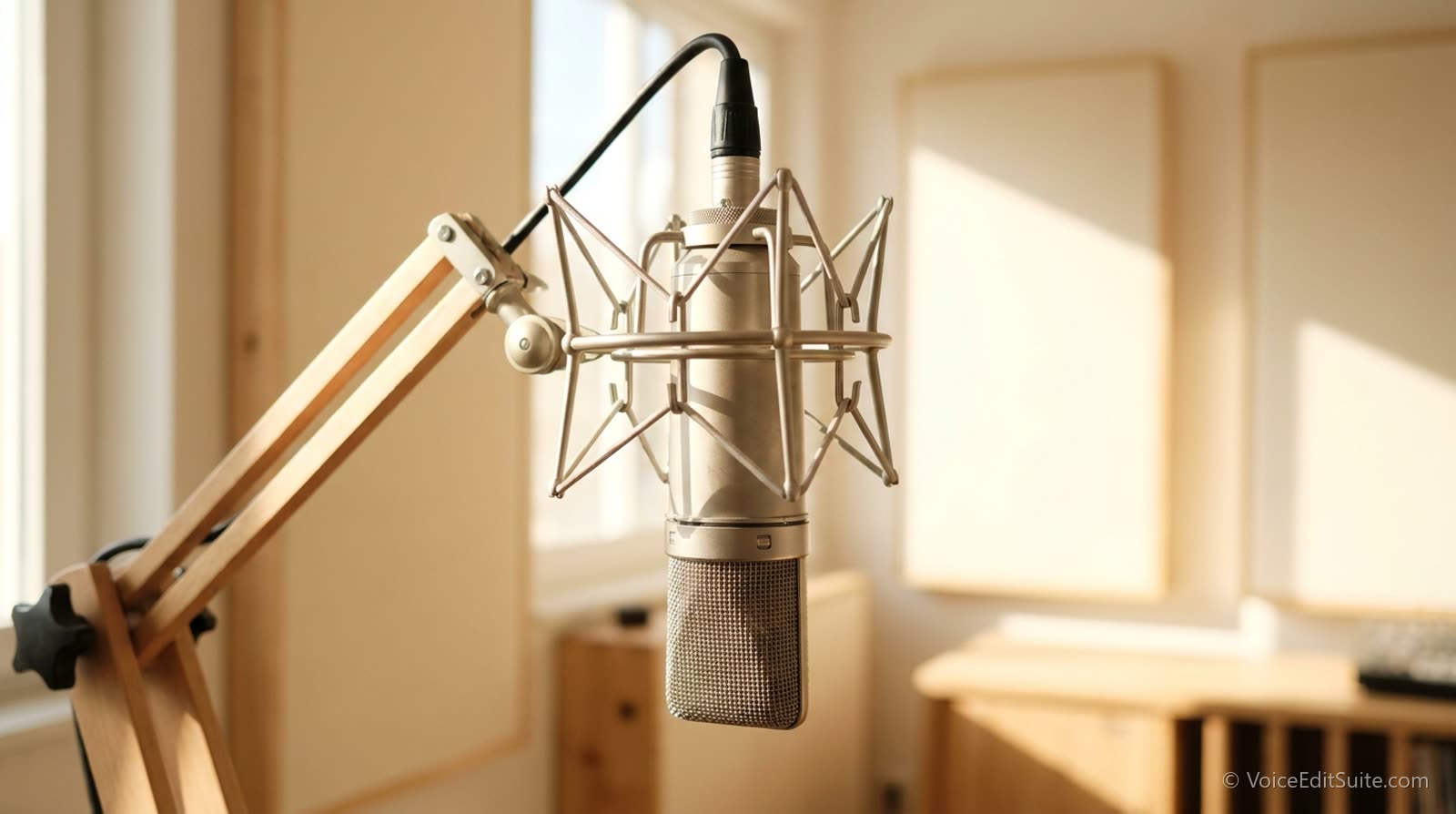
Every microphone is, by design, extremely sensitive to small movements of its capsule. That sensitivity is what makes it good at capturing a voice, and it's also what makes it pick up vibration traveling through a desk, a floor, or a stand that a human ear in the room would never notice. Ground loop hum is the electrical version of an invisible noise problem; vibration is the mechanical version, and it gets misdiagnosed just as often.
How Much a Shock Mount Actually Cuts
The biggest single jump in that comparison isn't the shock mount itself, it's getting the stand off the same surface your keyboard, mouse, or elbow rests on. A shock mount absorbs vibration traveling through the stand into the mic clip; it does nothing for vibration your desk is transmitting into the stand's base in the first place if that stand is bolted directly to the same desk you're typing on.
What Each Piece of Gear Actually Solves
- A shock mount isolates the mic capsule from vibration traveling up through the stand or boom arm itself, footsteps, a door closing nearby, the stand being bumped. It does not stop airborne room noise or acoustic reflections.
- A boom arm off a separate stand or floor mount, rather than clamped to your desk, removes desk-transmitted vibration at the source: typing, mouse clicks, a knee bumping the desk underneath.
- A desk decoupling pad or isolation platform under a desk-mounted stand's base is a cheaper partial fix when a full floor stand isn't practical, though it never fully matches getting the stand off the desk entirely.
- Acoustic foam or a reflection filter solves a completely different problem, airborne reflections and room reverb, and does essentially nothing for structure-borne vibration. Confusing the two is one of the most common gear-buying mistakes in a home studio.
Diagnosing Which Kind of Noise You Actually Have
Tap the desk itself, away from the mic, while monitoring the recording level. If that thump shows up clearly, you have a structure-borne vibration problem and a shock mount plus getting the stand off the desk is the fix. Next, clap or talk from across the room with nothing touching the desk at all. If that produces a boomy, hollow, or echoey quality rather than a thump, that's acoustic reflection, and no amount of shock mounting will touch it; you need room treatment instead. Most home studios that report "weird noise in my recordings" actually have some of both, but treating the wrong one first wastes money without fixing anything.
↗ Try the tool
Studio Rescue
Not sure whether what you're hearing is vibration, room noise, or gain staging? Studio Rescue diagnoses the actual source before you spend money guessing at gear.
Open Studio Rescue →Where to Spend and Where to Skip
A basic elastic shock mount in the $15 to $30 range does nearly as much good as a $100 premium one for typical home studio use; the diminishing returns kick in fast once you're past a functional isolation design. A boom arm, by contrast, is worth spending a little more on, since a cheap one that droops under a mic's weight or squeaks when adjusted becomes its own noise source. If budget forces a choice between the two, prioritize getting the stand off your desk over upgrading the shock mount sitting on it.
Frequently Asked Questions
Do USB microphones need a shock mount too?
Yes, the same way an XLR mic does. The USB versus XLR distinction is about signal path and connection, not about mechanical sensitivity to vibration, which affects both equally.
My microphone came with a built-in shock mount cage. Is that enough?
Often, yes, for moderate vibration. It's still worth doing the desk-tap test above, since a built-in mount handles vibration reaching the mic body but does nothing extra if the whole stand is transmitting noise from a desk you type on.
Does this matter more in an apartment?
Often, since shared walls and floors in apartments transmit low-frequency structure-borne noise, footsteps from a neighbor, a shared building's HVAC, more readily than a detached house's floor typically does.