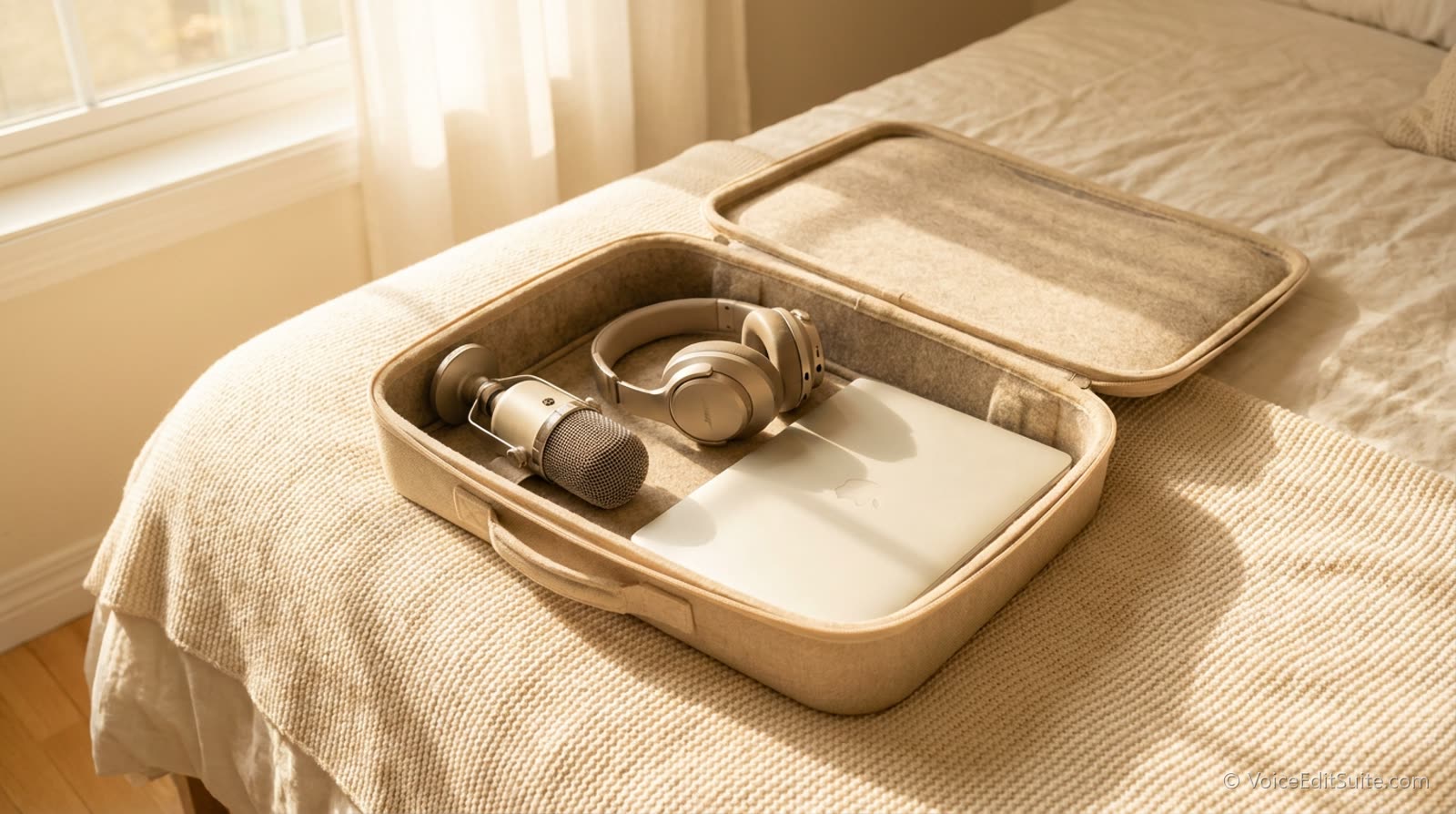
Every working voice actor eventually gets the email that starts with a deadline and ends with them somewhere other than their booth: a family trip, a convention, a week covering for a parent. The instinct is to bring everything. The better move is to bring the small list of things that actually solve the two problems travel recording has, which are not the same two problems a home studio has. At home, the fight is against your own room's echo and hum. On the road, the fight is against a room you did not choose and cannot treat, plus the noise floor of a building full of other people.
The Kit: What Actually Earns Its Space in a Bag
- A dynamic USB microphone, not a condenser. The distinction between USB and XLR matters less here than the distinction between dynamic and condenser: a dynamic capsule rejects more of the room around it, which is exactly what an unfamiliar space needs. A condenser hears everything, including the hotel hallway.
- A closed-back headphone, small and foldable, for monitoring without a speaker leaking into the take.
- A short XLR cable and a compact interface, if your mic is not USB, small enough to live in a side pocket rather than a dedicated case.
- Two blankets or a travel duvet cover, packed as clothing padding on the way there so they earn their weight twice.
- A laptop stand or a stack of books, so the screen and keyboard sit far enough from the mic that fan and typing noise stay off the recording.
- A pop filter that folds flat, or a cheap foam windscreen as a backup that survives a suitcase better.
Faking a Booth Out of a Hotel Room
A hotel wardrobe, hung full of clothes, with the door closed most of the way around you, is the closest thing to a portable vocal booth that does not require checking a box on the airline. Clothes are irregular, absorbent, and dense, which is exactly the combination that kills reflections without the awkward geometry of foam. If there is no wardrobe, the same trick works with a blanket-draped area between the bed's headboard and a couple of dining chairs. The goal is not silence, it is deadness: a space where a clap produces no ring, because that ring is what a hotel room's hard walls and glass windows are built to produce in abundance.
Time of day matters more away from home than it does in your own studio, because you cannot control the building's schedule. Housekeeping carts, elevator dings down the hall, and street noise through single-pane glass all have patterns, and the quietest predictable window in most hotels is late morning after cleaning staff finish a floor and before checkout traffic peaks. A quick knock-test on the walls tells you more than the room's star rating: a dull thud means real mass between you and the next room, a hollow tap means the opposite, and no amount of blanket-draping fixes a wall that is thin, only what happens on your own side of it.
What Actually Moves the Needle on the Road
The HVAC fan in most hotel rooms runs at a steady, unglamorous hum that is easy to stop noticing and impossible for a microphone to ignore. Switching it off for the length of a take, then back on between takes so the room does not get stifling, costs nothing and removes a noise floor problem no amount of software fully undoes cleanly. The same goes for a mini-fridge, which a surprising number of hotel rooms will let you unplug for an hour without incident.
Matching Your Home Sound, Not Just Making Something Usable
A client who has heard your home studio sound expects to hear roughly the same voice back, and a travel take that is merely acceptable but audibly different, brighter, boxier, more distant, reads as a downgrade even if nobody can say exactly why. The fix is consistency of gear more than perfection of room: the same microphone, the same rough mic distance, and gain set to the same target level you use at home, around -12 dB on your peaks, gets you close enough that a listener adjusts rather than notices. Taking direction remotely over Source-Connect or Zoom works the same way from a hotel as from a studio, provided the connection is stable, so confirm the room's wifi before the session, not during it.
↗ Try the tool
Home Studio Analysis
Home Studio Analysis works just as well on a hotel room. Run thirty seconds before your first real take: it measures the echo tail, noise floor and hum right there and tells you whether the wardrobe trick is enough or you need to find a quieter room.
Open Home Studio Analysis →Frequently Asked Questions
Do I need a separate audio interface for travel, or is a USB mic enough?
A good USB dynamic mic is enough for the vast majority of travel jobs and removes a point of failure. Choosing between USB and XLR at home is often about scalability; on the road it is mostly about how much you want to carry and how many things can go wrong at once.
Will clients accept a travel recording, or should I turn the job down?
Most will, if you tell them in advance rather than after the fact and the measured noise floor and echo are genuinely close to your usual numbers. Set expectations before the session: a short, honest heads-up that you are recording away from your main setup, with a sample if the job is high-stakes, avoids an awkward conversation after delivery.
Can this whole kit fit in a carry-on?
Yes. A USB dynamic mic, a folding pop filter, closed-back headphones, and a laptop stand together weigh and pack about the same as a pair of shoes. The blankets are the only bulky item, and most travel voice actors simply use the room's own bedding and towels instead of packing their own.