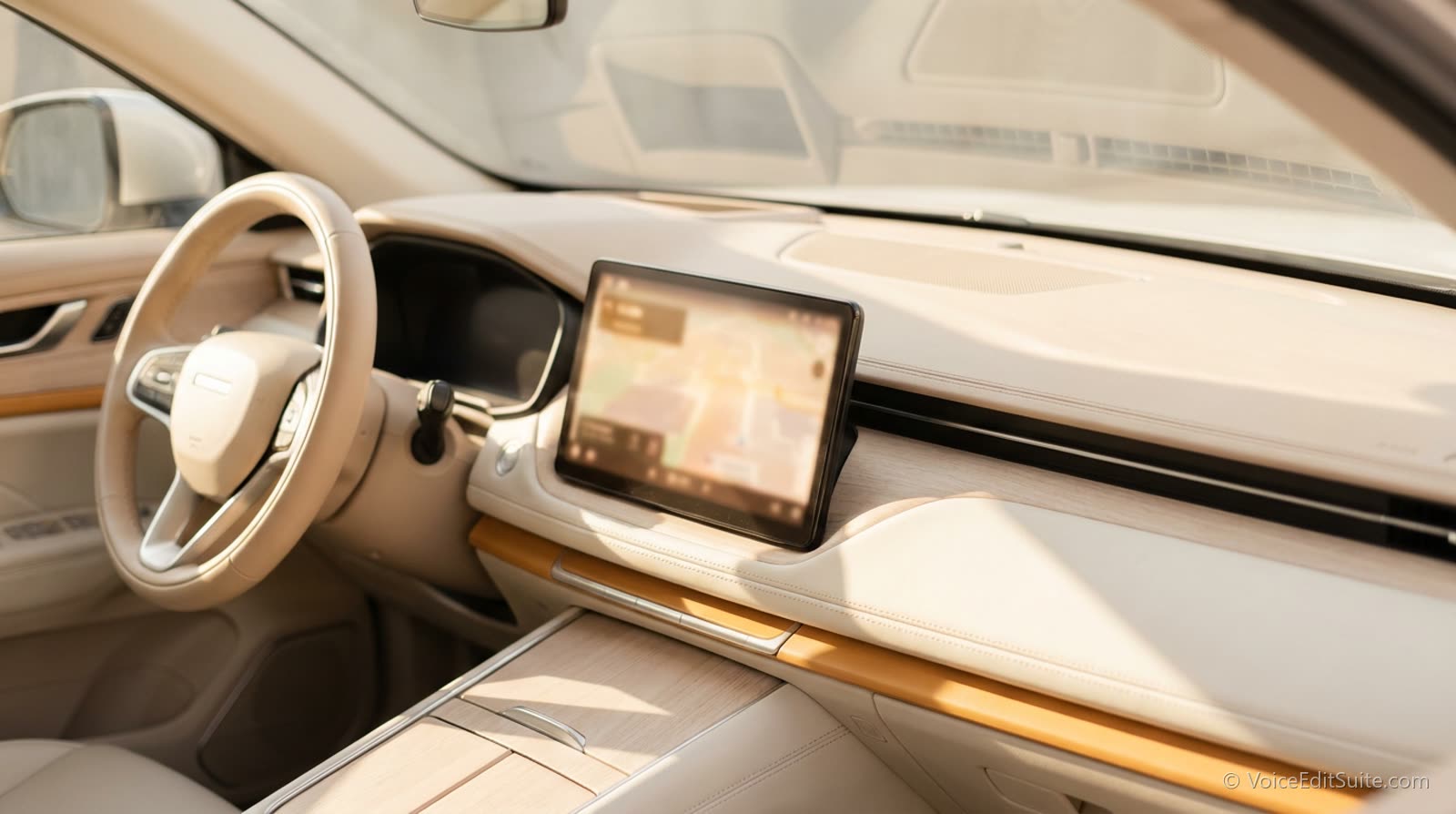
Navigation systems, in-car infotainment, and automotive safety alerts make up a steady, largely invisible corner of the voice over industry: work that drivers hear constantly and think about almost never, which is exactly the point. A good automotive voice recording disappears into the experience of driving; a bad one becomes the thing a driver complains about. That invisibility is the whole job, and it calls for a genuinely different skill set than most other voice over niches.
Consistency Matters More Here Than Almost Anywhere Else
A single navigation system's prompt library can run into the thousands of short phrases and words, recorded so they can be recombined by the system into full sentences on the fly, turn left in, five hundred feet, onto Main Street. Every one of those fragments has to match the others in pace, tone, and energy closely enough that a listener cannot tell where one recorded piece ends and the next begins. This makes automotive work far less forgiving of an inconsistent session than a single continuous script would be; a fragment recorded an hour later at a slightly different energy level stands out immediately once it is recombined with the rest.
- Neutral, clear pacing for turn-by-turn instructions. The goal is comprehension at a glance, not personality.
- A calm, unhurried tone for safety alerts, even when the message itself is urgent. A panicked-sounding voice is a worse safety design than a calm one delivering the same warning.
- Brief, consistent phrasing for infotainment confirmations, since these get heard dozens of times a day and need to stay unobtrusive.
- A warmer, more distinct tone reserved for brand personality moments, where a manufacturer wants the voice to feel more like a character than a utility.
The Technical Side Is Genuinely Demanding
Sessions for this kind of work are often scripted as long lists of isolated words and short phrases rather than flowing sentences, which is a different kind of vocal stamina than reading continuous copy; there is no narrative momentum to carry you from one line to the next, only the discipline of matching your own delivery hundreds of times in a row. Marking up a script for consistent pacing before a session like this is less about performance notes and more about literally tracking which phrasing pattern you used, so line four hundred matches line twelve.
This niche overlaps with IVR and phone system work
The same discipline required for recording IVR and on-hold prompts, short, consistent, recombinable phrases, transfers almost directly into automotive voice work, and voice actors who already do one often find the other a natural extension.
Rates for this kind of work follow usage terms that look different from a typical commercial or corporate booking, since a navigation voice can end up shipped in millions of vehicles over a multi-year model run. Understanding usage rights and how they scale with distribution matters as much here as in any other niche, and arguably more, given how long a single automotive contract can stay in active use once it ships.
↗ Try the tool
Rate Calculator
Free to try: automotive and navigation projects rarely fit a standard rate card. The Rate Calculator helps scope a quote around actual usage terms and prompt volume rather than guessing at a niche project's real value.
Open Rate Calculator →Invisible by Design, Demanding in Practice
Automotive and navigation voice work rewards a narrow, specific skill set: total consistency across a large volume of short recordings, and a delivery style built to disappear rather than stand out. It is not a glamorous niche, but it is a stable one, and the technical discipline it demands is genuinely transferable to other high-volume, phrase-based voice over work.